United Nations Peace Operations and International Relations Theory by Kseniya Oksamytna & John Karlsrud
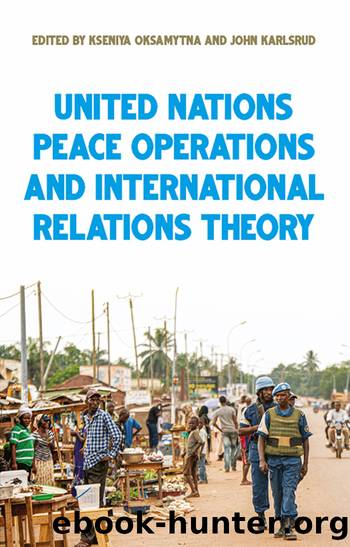
Author:Kseniya Oksamytna & John Karlsrud [Oksamytna, Kseniya & Karlsrud, John]
Language: eng
Format: epub
ISBN: 9781526148872
Goodreads: 50699345
Publisher: Manchester University Press
Published: 2020-08-11T00:00:00+00:00
UN peacekeeping in the Democratic Republic of Congo
The United Nations Mission in the DRC (MONUC/MONUSCO) was first deployed in late 1999, three years before the formal end of Congo's epic war.7 The mission is the UN's largest and most expensive peacekeeping operation to date, and over the last two decades it has been at the forefront of new peacekeeping practices and norms (e.g. protection of civilians, stabilisation). Its ambition and authorised robustness have steadily increased, largely in response to continued violence and instability in the country. In 2008, under Resolution 1856, MONUC became the first mission to operate with a mandate that designated PoC as the highest priority.8 And in 2013, the Council deployed the Force Intervention Brigade (FIB), a specialised unit within MONUSCO, authorised to take offensive military action to âneutraliseâ and âdisarmâ rebel groups (UN Security Council 2013: 7â8). The mission has also been a driving force behind the development of innovative peacekeeping practices, and operational mechanisms and guidance developed by MONUC/MONUSCO have been replicated in other mission contexts.9
Yet these ambitious plans and policies have been inconsistently implemented in practice: as much as the mission has been lauded for its innovation and celerity, it has been lambasted for what many have seen as its ineffectiveness, impotence, and inconsistent implementation of its mandate. After two decades of UN involvement, both the country and the mission are in a precarious state. An array of armed groups remains deeply ensconced in the eastern part of the country and continues to threaten civilians whom peacekeepers are charged with protecting. Armed conflict and intercommunal tensions have arisen in previously stable areas.10 Peacekeepers have been killed and injured in some of the worst attacks against the UN in recent history.11 And the government has spent much of the last two years in the throes of a constitutional crisis as Kabila's oppressive regime clings to power, forestalling elections that were due to take place in 2016 (Human Rights Watch 2018). For millions of Congolese, the future is bleak.
The protracted nature of instability in Congo, as well as the mission's scope and scale, has attracted scholarly interest. Nonetheless, there are still important issues worthy of study that are relevant to other missions, and for which constructivism provides analytical purchase.
First, at the more micro-level, gaps remain in our understanding of peacekeeping practice and specifically how norms get interpreted and implemented within and across the mission. Peacekeeping is supposed to be a quintessentially norm-governed activity. Yet the exact meaning and requirements of a norm are always contested (Krook and True 2010: 122â3; Wiener 2004: 191â2; Stimmer and Wisken 2019). Even a norm like impartiality â long part of the âholy trinityâ of guiding norms for peacekeeping â can be reinterpreted over time and in particular places (Paddon Rhoads 2016: 48â52). A constructivist lens can help us understand the process by which norms shape peacekeepersâ day-to-day practices in Congo and beyond, and the ways in which those practices affect broader processes of norm contestation.12
This is particularly relevant in a context like Congo, where the record of peacekeeping practice is highly variable.
Download
This site does not store any files on its server. We only index and link to content provided by other sites. Please contact the content providers to delete copyright contents if any and email us, we'll remove relevant links or contents immediately.
The Secret History by Donna Tartt(19092)
The Social Justice Warrior Handbook by Lisa De Pasquale(12191)
Thirteen Reasons Why by Jay Asher(8912)
This Is How You Lose Her by Junot Diaz(6889)
Weapons of Math Destruction by Cathy O'Neil(6281)
Zero to One by Peter Thiel(5802)
Beartown by Fredrik Backman(5756)
The Myth of the Strong Leader by Archie Brown(5509)
The Fire Next Time by James Baldwin(5447)
How Democracies Die by Steven Levitsky & Daniel Ziblatt(5219)
Promise Me, Dad by Joe Biden(5154)
Stone's Rules by Roger Stone(5088)
A Higher Loyalty: Truth, Lies, and Leadership by James Comey(4964)
100 Deadly Skills by Clint Emerson(4926)
Rise and Kill First by Ronen Bergman(4790)
Secrecy World by Jake Bernstein(4753)
The David Icke Guide to the Global Conspiracy (and how to end it) by David Icke(4720)
The Farm by Tom Rob Smith(4514)
The Doomsday Machine by Daniel Ellsberg(4490)
